

Long-term Qualitative Analysis of Regional Distribution of Electricity Increment in China
Category: Company News
2018-05-29
When making investment decisions on power supply projects such as coal power, gas power and nuclear power, the balance of commonly used electricity power is used to measure the power surplus and power equipment utilization hours in the next few years, and to measure the economy of power supply projects in combination with parameters such as electricity price, fuel price and unit cost. Electricity balance is a short-term quantitative prediction tool, the prediction accuracy is high in 2 to 3 years, the prediction accuracy of 3 to 5 years decreases, it is difficult to predict the power supply and demand and utilization hours after 5 years. The construction period of coal power and gas power is 18-24 months, and the construction period of nuclear power is 5 years. The predicted power surplus and utilization hours at the time of investment decision-making will decrease or even fail when the project is completed.
The operating life of coal power and gas power is 30 years, and the operating life of the third generation of nuclear power is 60 years, which requires supporting long-term forecasting tools to assist investment decisions. Energy models are quantitative tools for forward forecasting, usually coupled with top-down energy economic models and bottom-up energy technology models. No matter what kind of model, it is system engineering, which needs massive database and huge workload of professional team as support. The predictions of energy models are susceptible to exogenous given variables.
Most research institutions believe that because of the low level of per capita electricity consumption in the central and western regions, the future growth rate of electricity consumption will be higher than that in the eastern region (qualitative judgment, exogenous variables), which is the main force of electricity consumption growth. This paper uses a minimalist qualitative analysis method, focusing on a single variable-population, to analyze the regional distribution of China's long-term increase in electricity consumption, and thinks that the distribution of industries with large increases in electricity consumption in the future is highly related to population aggregation and distribution. Referring to the experience of Japan's population and electricity consumption after reaching its peak, and analyzing the change law of China's total population and mobility, the author believes that the east of the Hu Huanyong line, especially the southeast coast, as the future net inflow area of population, will be a high-growth area of electricity consumption, and a good business environment, is the best quality power market in China.
Industry distribution and population distribution are highly correlated with high growth in electricity consumption.
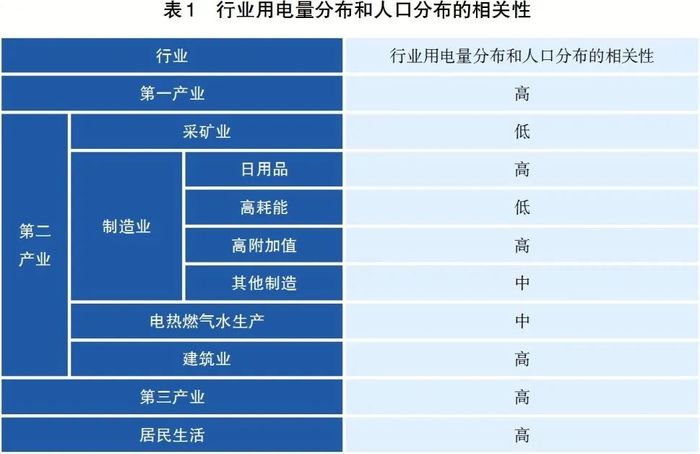
In order to analyze the regional distribution of electricity consumption, the author first analyzes the correlation between the distribution of various industries and the distribution of population (see Table 1 for details).
Electricity consumption on the production side (primary and secondary production): geographical and climatic factors such as altitude and precipitation affect the distribution of primary production and then population distribution, and a considerable part of primary production is labor-intensive, and the regional distribution of primary production is highly correlated with the distribution of population (workers). In the manufacturing industry, the daily necessities manufacturing industry is a labor-intensive industry; high value-added industries require high-quality workers, and high-quality workers tend to live in prosperous areas with better resources such as education and medical care; the construction industry is in populated areas Build houses. Only a few industries, such as mining and high energy-consuming industries, can be relatively separated from industrial distribution and population aggregation, and the population correlation is low.
Electricity consumption on the consumer side (tertiary production, living) is highly correlated with the distribution of electricity and population distribution.

这里是标题一h1占位文字

Business contact:
Mr. Wu: 15322054255
Miss Wang13827769412
Huarui Service Phone:0757-87653135
Enterprise E-mail:
Company Address:
Block 7, No.5, Lequn Avenue, Liping Town, Sanshui District, Foshan City


